








Featured in this posts
Why So Many Folding eBikes Still Feel Too Big
You bought a folding eBike to make your life easier. Maybe you imagined rolling it into your apartment hallway, sliding it under your office desk, or dropping it neatly into a car trunk.
Then the bike arrived, and reality hit differently. Even after folding the bike, it still feels large.
This is the real disappointment that makes people question why folding eBikes still feel too big for everyday life.
Folding Does Not Always Mean Convenient
Compact on Paper, Bulky in Practice
A bike can fold and still feel genuinely difficult to live with. At first, that may sound strange, but once you experience it firsthand, it makes complete sense.
The first issue is the large folded footprint. Many folding eBikes collapse to a smaller shape, but that shape is still large. You can take a suitcase, for example, that folds in half but is still too wide to fit through a narrow doorway without turning sideways. Likewise, the bike may technically fold, but it takes up significant floor space.
Then there is awkward handling. Folding does not automatically make a bike easy to move. The frame angles, position of the wheels, and the way the bike distributes its bulk when collapsed all of these determine how natural or frustrating it feels to move the bike around.
Again, some eBike designs are almost impossible to neatly store against a wall or inside a closet because the folding geometry simply doesn't cooperate. In this case, storage becomes a puzzle rather than a solution.
Folding Solves Storage, Not Everything
Folding a bike makes it smaller, but it does not make it lighter. It also does not automatically make it easy to lift, transport, or maneuver.
This is where folding bike portability often falls short of expectations. On paper, a folding bike sounds easy to transport. In real life, things can be different. If the bike is heavy or awkward to hold when folded, carrying it up apartment stairs, lifting it into a car trunk, or taking it onto public transportation can quickly become frustrating.
What Actually Makes an eBike Feel Compact?
Carrying Experience Matters
Balance plays a big role here. A bike with a low, uneven center of gravity feels heavier than it actually is. Frame shape also affects; some designs provide natural grip points, making them easy to carry. Others force your wrist into awkward angles that strain the arms and back.
A truly folding eBike should feel manageable from the first lift, not just look impressively small in product photos.
Folded Shape Matters Too
Compact dimensions are not the whole story. A bike that folds to a small size still needs to fit the actual shapes of your car trunks, elevator corners, apartment entryways, and under-desk spaces.
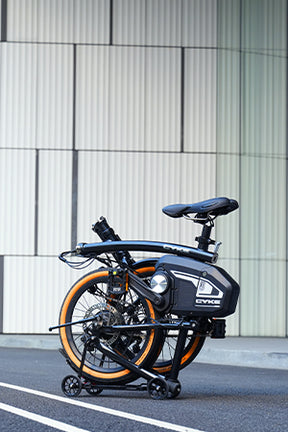
Folded geometry changes everything in practice. Some bikes collapse into a tall, narrow shape that is nearly impossible to balance on its own. Others fold wide and flat, which makes them awkward to carry but reasonably stable on the ground. The most comfortable designs collapse into something close to a stable rectangular block, which is stable, predictable, and easy to tuck away.
Some bikes are really hard to store neatly indoors. They become wobbly when propped up against a wall. The real difference between ‘technically small’ and ‘really easy to use’ is something most buyers discover only after the bike arrives.
Transportation Changes Everything
Transportation is where true compactness becomes important.
A genuinely compact folding eBike makes mixed-mode commuting much easier. It transitions smoothly between riding, walking, trains, buses, and other vehicles.
Folding eBikes are especially valued for this flexibility because they can integrate with public transportation and fit into small living spaces.
Why Many Lightweight Folding eBikes Feel Limited
When designers push hard to reduce folding eBike weight, it comes with compromises. The lighter the bike, the more compromises have to be made, and that is usually in riding performance.
Simpler Systems Keep Weight Down
Lightweight folding eBikes typically use hub motors. These motors sit directly inside the wheel hub and require a relatively simple drivetrain to work.
The result is a simplified system that reduces overall complexity and performs well on flat terrain and shorter rides, but loses capability when the route gets more demanding.
This is not a flaw. It is simply a design priority of keeping things light.
Ride Quality Still Matters
A heavy folding eBike can feel like a burden in your hands, but it can offer real benefits once you start riding, especially on hills or rough city streets.
For short, flat commutes, a lightweight hub-drive folding eBike might work perfectly well. But daily riding is not always that simple. There are hills and stop-and-go traffic that demand confident braking and smooth acceleration. There are moments where stability at speed, or under load, becomes genuinely important.
When a bike struggles in these real-world situations, rider confidence disappears quickly. This is why some riders eventually move beyond lightweight-focused designs. They begin prioritizing riding performance alongside portability.
Why Some Riders Accept a Heavier Folding eBike
Mid-Drive Systems Add Capability
A mid-drive folding eBike positions its motor at the bike's bottom bracket, right at the center of the frame, near the pedals. This improves weight distribution and allows the motor to work through the drivetrain.
The result is stronger climbing performance, smoother power delivery, and a more natural riding experience.
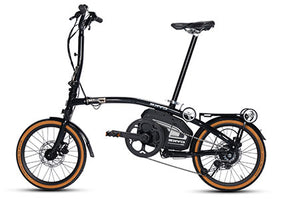
The Kingfisher e-bike is the perfect example of this approach applied to a folding design. It delivers mid-drive performance inside a tri-fold frame that collapses to just 28.74 × 14.57 × 27.56 inches. The 250W motor produces 65Nm of torque and pairs with a high-sensitivity torque sensor that matches power output to your pedaling in real time.
For many riders, this creates a balance between portability and capability that is difficult to achieve with lighter systems.
Real-World Usability Matters More
Daily riding is not just about carrying a bike. It is about feeling confident when using it.
An urban commuting eBike needs to perform under actual conditions, not just score well on a spec sheet. Rider confidence, physical comfort, and consistent capability across hills, traffic, and varied terrain are what determine whether you genuinely enjoy using your bike regularly.
Likewise, the best compact commuter bike is not necessarily the one with the smallest folded dimensions. It is the one that fits your route, your storage situation, and your riding habits, all at the same time.
Final Thoughts
Why folding eBikes still feel too big is really a question about the gap between what a bike promises and what it delivers in real life.
Folding solves one problem. But storage, carrying comfort, balance, transportation, and ride quality all influence whether a bike truly feels compact in daily life.
True compactness comes from a combination of smart design, practical usability, and real-world performance. When those elements work together, a folding eBike feels less like something you have to manage and more like something that naturally fits into your day.


